2025:Year in Review
Friction, in practice
As a continued practice from previous years in 2021, 2023, 2024, here is a reflection about 2025.
At Original Muscle Beach, just south of the Santa Monica Pier, adults practice being beginners in public. The regulars look like they were built out of clay and sunshine. The tourists hover at the edge, pretending they are only watching. People trade advice about joints, leverage and sleep. Almost nobody talks about work.
I have always liked this about the place. It's a place where effort is physical and honest. The body gives immediate feedback. No one can fake how something feels. You try something, and you feel it straight into your wrists, your core and your breathing.
This year, I realized my body was telling me another truth too: the life I was building didn’t feel good from the inside.
My year of 2025 didn't have a theme originally. All I knew was that I wanted to grow Figures & Figures and make it real. Somewhere in one of my first sessions with my business coaching program, Dan said something that lodged itself in me. I can’t quote it perfectly, but the meaning was blunt:
“Why do you expect friction not to be part of your business?”
For most of the year, I treated “friction” like a kind of tax you pay for building something meaningful. Now it feels more like information. Friction is normal when you do hard things. But I've started to see it more like a clue: the shape of my days was fighting the shape of my values.
In 2025, every small decision began to cast a shadow. What were my choices adding up to? What were they costing me? When I stepped back to look at the larger picture, I didn’t like what I was seeing.
Part of my discomfort is that many of my biggest decisions were made lightly, in the way you say yes when the yes is easier than imagining the alternative.
- In 2015, I moved to the U.S., running away from a bad relationship as much as toward a dream.
- In 2017, I stayed because it was convenient and because I could get the education I wanted.
- In 2019, I quit my full-time job to go out on my own because the opportunity showed up.
- In 2022, I moved to New York because I wanted to see if I’d miss Los Angeles, and because Pentagram sounded like a pretty dope opportunity.
This year was my ten-year anniversary in the U.S., and it landed with more weight than nostalgia. It felt like a reckoning. I want to be more purposeful about my life, and about how work decisions shape it.
What do I want my rich life to look like?
When I hear about people talking about their rich life, I see a version of “rich” that is easy to picture: a life full of things, experiences, fun. Mine is a bit harder to render.
What I’m looking for is a life designed for internal calm and spaciousness. It might sound simple but for someone as agitate and anxious as I am, this is the challenge of a lifetime.
In practice, that means:
- I want work that feels purposeful in a tangible way: helping people make better decisions through better information for a better word.
- And I want the experience of the work to matter as much as the output. I want to build environments that treat people well, not just deliverables that look good in a case study.
- It also means I want a sense of home that is more than an aesthetic. Living away from my family and my childhood home has made “home” into something I have to design on purpose: a physical environment that feels ordered, intentional, and quiet. Fewer possessions, but chosen ones. Space that supports thinking, resting, and working without constant friction.
- I want relationships with a low emotional tax: a small number of people I don’t have to keep explaining myself to. Conversations that are substantive rather than performative. Emotional reciprocity without volatility.
- I want unclaimed time, too. Unscheduled time that is not framed as recovery from burnout. Time that belongs to no one but me.
- And I want play, specifically the kind that begins with physical movement. Original Muscle Beach ,and the goofing around on aerial equipment that happens there, is my proof-of-concept. It reminds me that effort can be joyful, and that being a beginner is not an emergency. I’m not a fun person in general (ask my husband), but there, I get to play without being judged. It brings balance back into my life. Emotionally as much as literally.
It’s a familiar trick of adulthood to treat “life” and “work” as separate categories, as if one is the part where you become yourself and the other is the price of admission. In real life, I found that they leak into each other constantly, and the leak is usually one-directional.
If I’m trying to design a life for internal calm and spaciousness, I have to start where the pressure originates most reliably: the way I work, and what I’ve allowed work to become.
About work
I have always wanted work to mean something. For years, I treated that as a virtue. But somewhere along the way, work acquired a second job: security. And then, discreetly, it started policing the rest of my life.
After this year, I finally find language for what felt off. It isn't that the work matters less. It's that I was chasing an endless quest to prove myself. Work has become an identity tied to effort, to responsibility, to being indispensable. I kept giving one hundred and fifty percent, and the reward was mostly that I could keep doing it.
This year was all about fighting for something simpler, and harder: a version of work that still has purpose, but also has room. Work that supports life, instead of consuming it. The year was chaotic. It was clarifying. It slapped me in the face (legally, phsyically, emotionally). But it also taught me what I need in order to do good work for a long time, and what kind of environment helps me do my best work.
Figures & Figures
As I announced in a very official Founder letter, Figures & Figures was launched this year.
I’ve wanted to do this for years. But I also spent several years not doing it: too overwhelmed by the idea of being responsible for other people. My call with Dan gave me the first real jolt of belief that I could build something responsibly.
So I spent the year doing three things:
- finding the right people to work with
- translating what I wanted the studio to be into something operational, not just conceptual
- testing whether the model could make financial sense
So yes, we ourselves, you reader and our clients some case studies...we’re behind. But I can say with confidence that the model worked, and that we worked with exceptionally talented people.
One of my biggest learnings with figures& figures (or "Fig") is that doing this well requires a certain kind of ruthlessness: clarity about how we work, so the work doesn’t cost the people doing it. My responsibility is to our clients, to serve them well, as much as it is toward our freelancers and internal team, to give them the best working conditions possible.
I have big plans for Figures & Figures. I’ll share more in another post.
Falling out of love with fractional
I’m conservative about financial risk, and I’ve been under pressure as the sole provider for my family. To give Figures & Figures a real shot without making money a daily emergency, I kept a separate pipeline outside the studio.
I carried some fractional contracts into 2025 and picked up another in the summer with a mission-driven client. I’m grateful for the trust, I'm excited about the work and I love the team. But I also learned something important about myself there: fractional isn’t my path forward.
There’s a special kind of responsibility that comes with being asked to shape experience, teams, tools, and processes. But embedded work has a ceiling. Too much of the day-to-day experience sits outside my scope, even when everyone is acting in good faith.
Honestly, I care too much about how the work gets done to leave that up to someone else's decision.
If I’m going to bring people along, I want to be responsible for the environment they’re working in, not just the output. That’s not something fractional work can reliably offer.
Closing down Elevate...
Alli, Will, Duncan, and I made a hard decision to close the Elevate Data Visualization Learning Community this year. In some ways, it was easier than I expected. In other ways, it felt like a failure because I had to put down something I still love.
Elevate is still one of my proudest achievements. I love the community, and I’m grateful we’re keeping the Slack open so the conversations can continue. If you read this and you were part of us, stick around! I may still do office hours there.
We stepped back because we all felt the same thing: at this stage of my life, we can no longer give Elevate the attention it deserved. Personally, I wanted it to have a full shot, or nothing.
It brought a lot of joy into my life. I made friends there. I hired many Elevate members. In French we say, ce n'est qu'un au revoir. This is only a goodbye, not a farewell.
Some data
Time data
I track my time every week with Timing, which does most of the work automatically for me. Personally, getting this data is crucial to my understanding of how I spend my energy.
Overall, this year again I worked about 50.5 hours/week and probably more, because the app only tracks everything that happens in digital spaces.
A rough percentage breakdown:
- Client delivery work: this is every minute spent on actual work (client meetings, hands down design, creative review...)
= 28%
- Figures & Figures (internal): everything from business development, admin, ops but also strategy, knowledge building...
= 26%
- Fractional work: delivery work for my fractional contracts
= 34%
A couple other numbers I noticed:
- Business development (inquiries): about 4 hours/week. Timour became our core strategist and handles most of our “pre-contract” strategy (business development), so I’ve been much more off that. It still takes time but this number has been decreasing every month.
- Fractional: that % means I was still operating like an embedded design leader for ~25 hours/week during the weeks I was working for my client. That's a lot of hours dedicated to growing someone else business. And this also why I won't be moving forward with more fractional after my current contract ends.
- Business strategy: about 2.5 hours/week. I'm proud of that one. I spent a lot of time thinking about the business an executing on it. Clarifying our offers internally, reviewing data to take decisions...
- Marketing / content: about 3 hours/week. This one is surprising to me. I guess it does take me longer than I thought to write blogs like this one.
I don’t have a perfect breakdown of how I spend client delivery time in details, but I know it’s still too high. I’ve been doing much more hands-on client work than I want to do anymore.
Money
I will write an in-depth breakdown in a future article. In the meantime, I’m going to simplify the breakdown today:
- Studio Gross income (including fractional work paid through the studio)
= $714,284.80 - Personal revenue I took from the studio: $92,771.78 salary + $10,203.94 distribution (after getting back the $40k I invested in the studio originally to get it off the ground)
= $102,975.72 - W-2 personal revenue from a client (Fractional):
= $78,888.00
The total personal revenue I paid myself was: $181,863.72
It’s less than last year. By choice. I was testing the financial model of the studio, and I expected to pay myself less.
Is that what I could practically took home? Not exactly. I took the decision to keep a decent buffer as cashflow in the business, around 70k I could have taken out. More on this in a future post soon.
Traveling
I’m not a huge fan of traveling. I don’t love flying. It’s uncomfortable, exhausting, and it always explodes my carbon budget. I like being home. But leaving home it still awesome sometimes. My favorite parts are eating new food, seeing wild landscapes, and making memories with people I love.
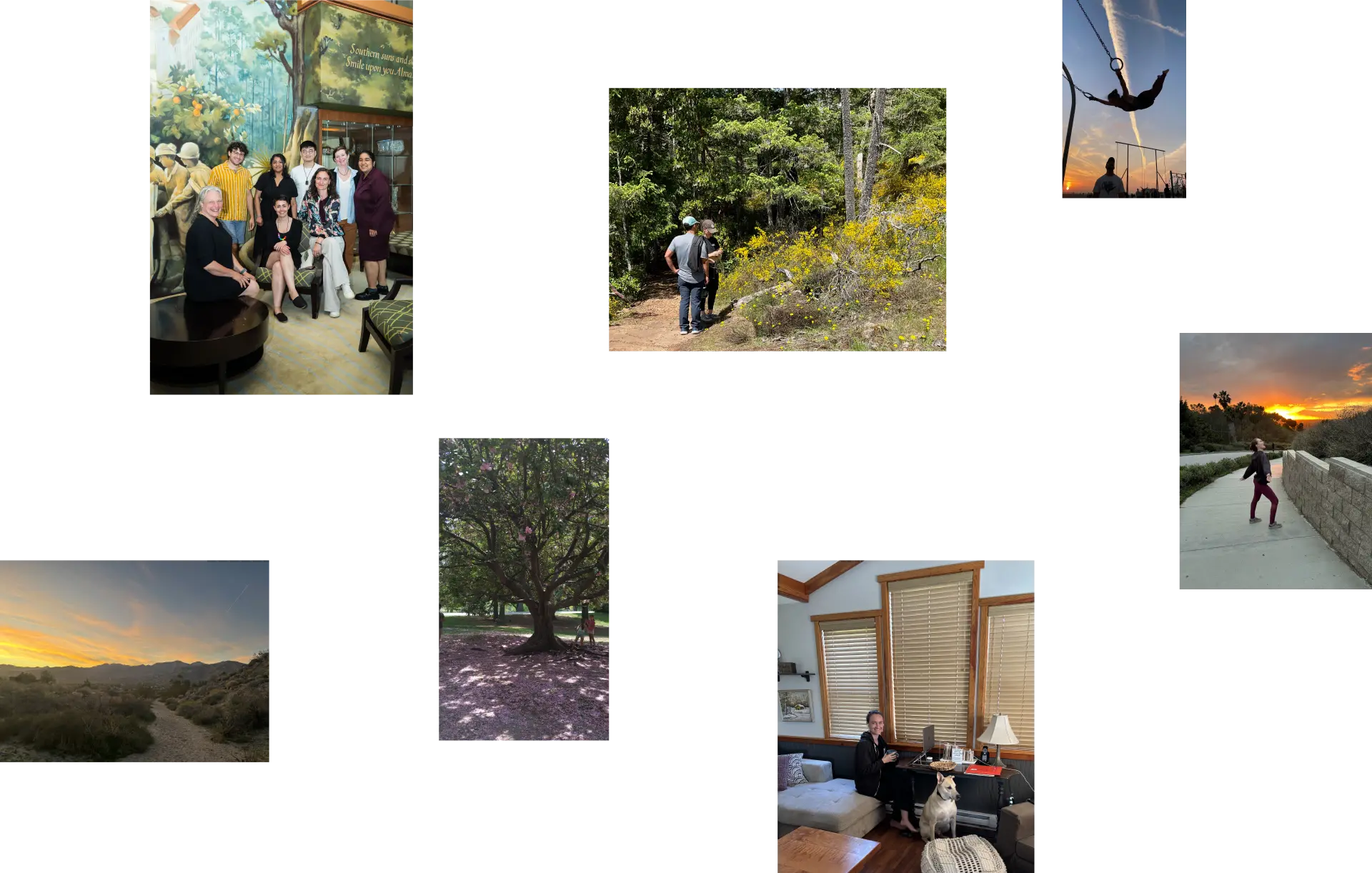
I went to several places this year that made me feel warm and fuzzy:
- A Chicago visit with the team to support a client through a fascinating exercise of facilitation and co-design
- London to visit one of my younger sisters
- New York to spend time at Pentagram with Giorgia and her team, see the cherry blossom trees and visit some friends
- France to see some of my family, old friends (human and furry ones), my hometown, see the South of the country, as well as discover new cities I hadn't been to (Avignon!)
- Doing the full Los Angeles > Canada road one more time to see the beautiful Victoria BC
- Palm Springs / Joshua Tree: an end-of-the-year desert reset with my partner and our dog...and miniature donkeys?
- Miami for the data visualization Outlier Conference
Taking time off
At the beginning of the year, I was challenged to take time off. Real time off. I scheduled it and then… it didn’t really happen.
Instead, I took three weeks off during the holiday break. It was the first time in... almost a decade.
What finally made me protect the time was the same thing that makes most decisions real: it wasn’t only my time. I wanted the rest of the team to get those three weeks, too.
Sharing more publicly
Last month, I said I’d post three times a week. I didn’t. I’m sorry.
I still haven’t found a way to share regularly without sliding into premade templates and AI-generated content. That approach doesn’t feel like me.
Still, I’m proud of what I did share, through my personal channels and through F&F, I wrote:
- 9 posts for The Information Design Insider
- 7 posts for How To Inform the World
- and many many Linkedin posts about data visualization guidelines, the issue with trying to use brand colors for data visualization, inspiring work, ... and more.
I’m commited to keep working in public. I even created a new CMS page on my personal website so these posts can live somewhere more permanent than Substack.
I’m also considering moving off Substack. I’ve been reading more about the ethical issues, and it doesn’t feel aligned with my values. I want to share more often, but I want to do it through platforms I believe in. I’ll let you know when this move happens.
There are other ways I’ve shared, often thanks to someone else giving me the space to do so:
- On the Elevate Dataviz Show podcast, where Alli, Duncan, Wll and I have been pouring our heart out about all things data viz, freelance, behind-the-scene.. for the last two years.
- At Outlier where I talked about my vision of the future of us, data visualization practitioners
- At the Observe Summit where I gave a talk about the 101 on how to make more impactful data visualization
So this my request of the day for you:
I love talking about everything information: how to communicate it, how to build data visualization design systems, why the way we've been working with data doesn't work in comms, how to create data visualization that gets Twitter all riled up.... If that might be useful for your podcast or conference or someone you know, hit me up.
2026: what I’m looking forward to
- A business retreat with Make More Money program (and some of my fav people there, looking at you, Joey Banks). I can't wait!
- More time off
- A move back to Europe (stay tuned for this). Going back to the homeland!
- The word for 2026: Systematization
For all of those who have been part of this exciting year of 2025: thank you.
Happy New Year everyone!
.png)